

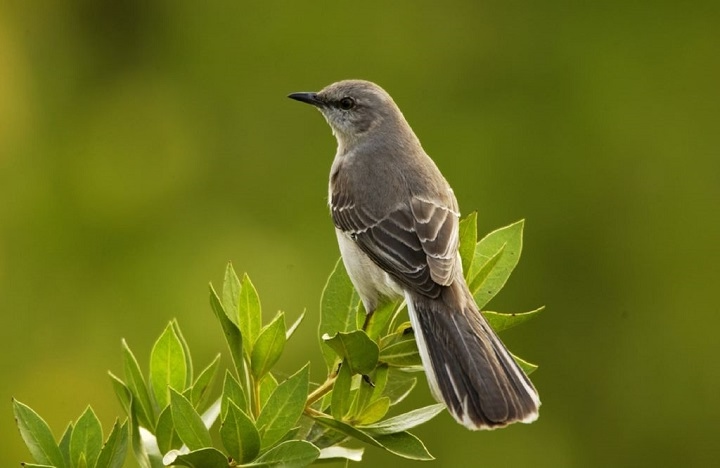
Mockingbirds are famous for their singing. They sing twenty-four seven. They sing like other birds, frogs, and even car alarms. They perch up high and let the world hear their song. Their gray color and long tails make them easy to tell apart.
But bird watching is never easy. Come into your yard or a park, and you spot a gray bird on a fence. Sleek body. Long tail. Fast flicks. You think, “Mockingbird.” It then meows like a cat. Or shows a black cap. Or departs flight without showing white wing patches. Now you have doubt.
That’s the test. There are many birds that look like mockingbirds. Some of them are kin. Others just happen to wear the same gray coats. In this guide, we’ll show you those decoys. We’ll describe their colors, songs, and behaviors. We’ll teach you how to distinguish them from actual mockingbirds. When we’re done, you’ll be seeing the hidden diversity in what at first glance seemed to be the same.
What Makes a Mockingbird Unique
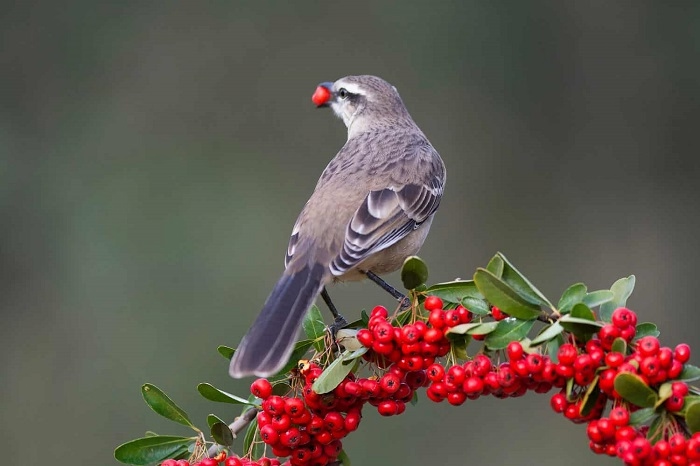
You need to know the mold before you notice imitators.
Northern Mockingbird Basics
- Size: Roughly 10 inches. Medium bird.
- Color: Gray back, lighter underneath. White wing patches flash when in flight.
- Tail: Long, often flicked or raised.
- Song: Endless variety. Mimics other birds and sounds. Males may sing over 200 distinct songs.
- Habitat: Defiant and territorial. Chases larger birds. Sings from elevated positions.
If you see a gray bird with white wing flashes and a consistent series of songs, you’ve likely got the Northern Mockingbird.
But nature abhors patterns. Other birds have some of these traits. That’s when confusion begins.
The Gray Catbird
The catbird is the mockingbird’s closest imposter.
- Size: Slightly smaller at 8–9 inches.
- Color: Streamlined slate-gray plumage.
- Head: Black cap.
- Tail: Darker gray with a hidden rusty-red spot under the base.
- Song: Mocks like a mockingbird, but scratchier and broken. Famous for its “mew” call, sounding just like a cat.
From a distance, you might mistake catbird = mockingbird. But the black cap and rusty undertail reveal it. Also, catbirds prefer dense shrubs, while mockingbirds prefer open perches.
Loggerhead Shrike
Shrikes are a trap for beginners.
- Size: About the same size as a mockingbird.
- Color: Gray back, white belly, black wings.
- Head: Outstanding black mask running through eye.
- Tail: Edged white, medium length.
- Song/Call: Chattering, harsh, not musical.
- Behavior: Hunts small animals and insects, but perches on wires. Also termed the “butcher bird” because it impales prey on thorns.
Its mockingbird-like gray body is intimidating, but its mask is unimposing when seen. Also intimidating are its hunting habits.
Townsend’s Solitaire
This sludgy gray thrush will deceive you.
- Size: Sleek and around 8 inches.
- Color: Even gray with indistinct buff wing stripe.
- Tail: Long and narrow.
- Song: High, flute-like notes, quite different from a mockingbird’s mimicry.
- Habitat: Western mountains and deserts.
At a distance, it looks like a subdued mockingbird. But no white wing patches when in flight, and its tendency to perch upright gives it away.
Blue-Gray Gnatcatcher
A lot smaller in shape, though.
- Size: Very small, 4–5 inches.
- Color: Pale gray-blue above, whitish below.
- Tail: Long relative to body, always flicked.
- Call: Thin, wheezy notes.
- Behavior: Active, never resting in a branch.
They tend to be mistaken for “baby mockingbirds.” But the little size and constant darting give away the illusion.
Clark’s Nutcracker
Not everywhere abundant, but very easy to mistake in mountain regions.
- Size: Bigger than a mockingbird, around 12 inches.
- Color: Gray body, black wings.
- Tail: Shorter and thicker.
- Call: Harsh croaks.
- Habitat: Mountain pines, western U.S.
Novices may mistake them for giant mockingbirds. But their stout bills and plump build give away they’re corvids, not mimics.
Eastern Kingbird
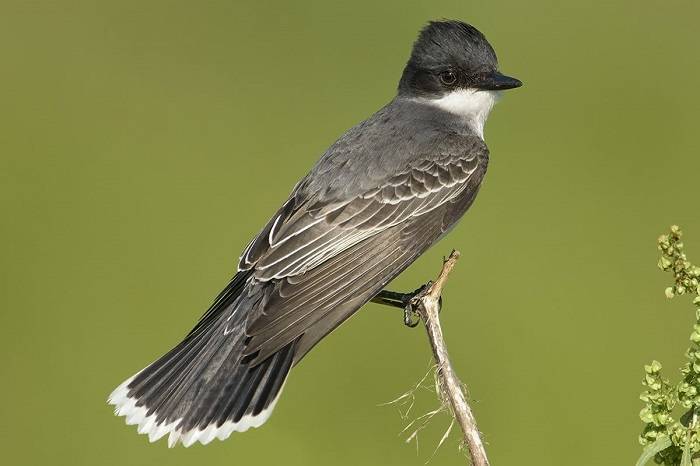
Another fence-sitter with a mockingbird looks.
- Length: 8–9 inches.
- Color: Dark gray-black dorsal surface, white underside.
- Tail: Black with sudden white tip.
- Call: Crisp “kit-kit” notes.
- Behavior: Blustery insect catcher, often sallying from a perch.
On initial glance, the blackish-gray and white coloration of the kingbird is misleading. However, the tail tip and stiff upright stance make the ID absolute.
Thrashers: Mockingbird Cousins
Thrashers are actual cousins of mockingbirds.
Brown Thrasher
- Size: Larger, 11–12 inches.
- Color: Reddish-brown above, streaked below.
- Tail: Extremely long, held low usually.
- Song: Mimics phrases like mockingbird but sings each twice.
Curve-Billed Thrasher
- Size: Same size as mockingbird.
- Color: Gray-brown spotted body.
- Bill: Long, curved, very unlike the straight beak of mockingbird.
- Song: Whistles and imitations.
Both deceive people because of long tails and are song imitators. But their bills and plumage betray them.
Juvenile Starlings
Young starlings in dull-colored plumage often cause trouble.
- Size: Medium, about the size of a mockingbird.
- Color: Gray-brown dull until their shiny adult plumage comes in.
- Tail: Less than a mockingbird’s.
- Call: Whistles, chatter, and imitations.
- Behavior: Often in large noisy flocks.
Single, a young starling can impersonate a mockingbird. But in groups, they betray themselves.
Sage Thrasher
Habitat: Dry regions.
Small relatives of the mockingbird, sage thrashers inhabit deserts.
- Length: 7–8 inches.
- Color: Gray-brown back, pale streaked belly.
- Tail: Long, rounded.
- Song: Extended and blended, sometimes mistaken for mockingbirds.
Sage thrashers are oftentimes confused with mockingbirds by western birders. Look closely at streaking to tell them apart.
Birds That Resemble Mockingbirds
| Bird | Common Difference From Mockingbird | Behavior/Habitat |
| Gray Catbird | Rusty undertail spot, black cap | Shrubs, mewing call |
| Loggerhead Shrike | Black eye mask, predatory | Open fields, fences |
| Townsend’s Solitaire | Plain gray, no wing flashes | Western deserts, mountains |
| Blue-Gray Gnatcatcher | Small size, flicking tail | Forest edges, active flier |
| Clark’s Nutcracker | Heavy bill, larger size | Mountain pines |
| Eastern Kingbird | White tip on tail, upright stance | Open fields, riversides |
| Thrashers | Brown/gray with curved bills | Scrub, deserts |
| Juvenile Starling | Gray-brown, shorter tail | Often in flocks |
| Sage Thrasher | Streaked belly, smaller body | Arid landscapes |
Field Tips: How to Tell Them Apart
Watch the Wings
Mockingbirds show white wing patches when in flight. Catbirds and thrashers don’t.
Study the Head
Mockingbirds have unmarked gray heads. Shrikes have black masks. Catbirds wear black caps.
Listen Carefully
Mockingbirds warble in connected songs, one after the other. Catbirds are raspy with “mew.” Thrashers repeat phrases twice. Kingbirds call suddenly.
Make a Note of the Habitat
Mockingbirds inhabit open lawns and suburban fences. Catbirds move behind bushes. Thrashers stay in deserts. Solitaires inhabit high mountain valleys.
Take Note of the Size
If it looks small, it’s a gnatcatcher. If it looks bulky, it’s a nutcracker. Mockingbirds are medium and lean.
Why It’s Important for Birders
Learning these differences enhances birding. What used to be “just another mockingbird” could well be a catbird, thrasher, or even a shrike. It sharpens observation. It helps with citizen science, as well, where accurate reports help with conservation.
Stories From the Field
Several birders have amusing stories of misIDs.
A novice birder spots a “mockingbird” in the mountains and is shocked to discover it was a Townsend’s solitaire.
Another sees a “mockingbird consuming a lizard” and learns shrikes are not imitators, but predators.
In spring, people tell of “mockingbirds meowing” until they learn the richness of catbirds in shrub thickets.
Mistakes are part of the fun. Each error instructs the eye and the ear.
Conservation Notes
Mockingbirds are plentiful, but doubles of them have a hard time. Shrikes decline in most places. Sage thrashers lose desert habitat. Catbirds depend on shrub cover, which vanishes in towns. Habitat conservation ensures that not only mockingbirds, but their doubles, survive to tell the story.
FAQs Regarding Birds That Look Like Mockingbirds
Which bird is most similar to a mockingbird?
The gray catbird. But its rust undertail and black cap set it apart.
How can a shrike be confused with a mockingbird?
Hunt for the black mask above the eyes and hunting habits.
Can juvenile starlings be confused with mockingbirds?
Yes. Their brownish-gray coloration causes confusion, but they lack white wing flashes.
Do all thrashers mimic songs like mockingbirds?
Most thrashers mimic but have different patterns. Brown thrashers repeat phrases twice.
Why are mockingbirds important in culture?
They are symbols of song, freedom, and imagination. They inspire literature and music with their mimicry.
Mockingbirds are famous but no exception to gray camouflage. Catbirds, shrikes, thrashers, solitaires, gnatcatchers, and even juvenile starlings resemble them. Initial glance, and confusion is easy. But if you look carefully, features emerge—caps, masks, wing flashes, and songs.
Birdwatching grows deeper when you learn to recognize these birds. You notice the behaviors, habitats, and sounds you once ignored. You see the uniqueness contained in what had been ordinary.
So next time a gray bird slaps its tail against a fence, ask yourself: is it actually a mockingbird? Or one of its clever imitators? The answer lies in a joy concealed in the details.
