

Some letters are abundant with bird names. C brings us cardinals, cranes, and crows. S brings us sparrows and swans. But what of U? It appears unusual. Near hidden. And maybe that’s the magic. Birds with U as a starter are scarce, but they leave a mark. They radiate presence. They inspire enigma.
Think of the boom of the umbrellabird over rainforests. The upland sandpiper stretches out its song over grassland. Or the ultramarine flycatcher flashing like an emerald amidst Himalayan mist. These are not birds you encounter every day. They’re the ones you remember. The ones that make you pull over and say it softly to yourself: unbelievable.
This is the tale of those U birds. Their shape. Their songs. Their significance. And their stories that recall us—sometimes the least likely letters are the richest.
Umbrellabird: The Shadow With a Crown
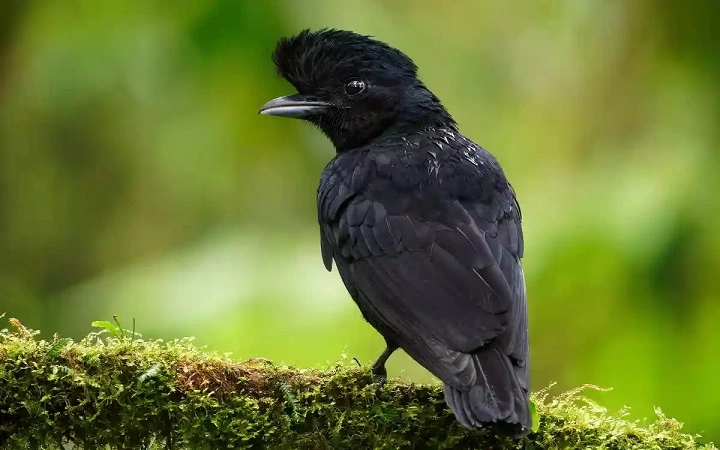
Walk into a rainforest. The air is thick. Shadows hold tight. And then you hear it. A boom. A boom like distant thunder. You look up. There it is—the umbrellabird.
Its body is a smooth, jet-black, camouflage-colored in forest darkness. There is a crest of feathers streaming forward like an umbrella on its face. For some forms, there is a drooping, hanging throat wattle that vibrates on every note. It looks strange. Dinosaur-like. But unforgettable.
Umbrellabirds live in Central and South America. They perch high up, surveying the forest. They eat fruit, insects, and small animals. They move at slow but steady pace, as if creatures who understand that the forest belongs to them.
But their universe is contracting. Rain forests are cleared. Year by year, they decline. To catch a glimpse of one today is to catch not only a bird, but a portent. And yet, to listen as that boom sounds through the trees is to feel that the forest is full of secrets it will never reveal.
Upland Sandpiper: The Grassland Nomad
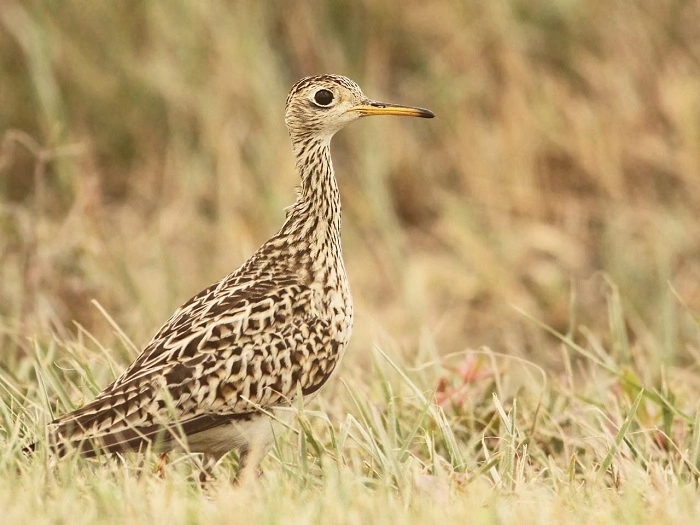
All sandpipers are not waterbirds. The upland sandpiper is an exception. No shorelines. No beaches. It calls the open grassland home.
Standing on its long neck, the birds’ slender body and small head look somewhat out of place on a fencepost. But hear it sing, and the prairie comes alive. Its song is extended, fluting, untrained. A wind’s voice, blowing across fields at dusk.
And then there’s the journey. This bird’s a road-trip warrior. Across thousands of miles, it’s traversed North American prairies to South American grasslands each and every year. No passport or map needed, just drive etched into wings.
The upland sandpiper is more than just a bird. It’s freedom feathered. A living reminder that wide skies and endless fields still have their guardians.
Uniform Crake: The Phantom of the Reeds
Imagine this: you’re strolling through a wetland. Reeds bend. Shadows shift. You catch a sharp, loud cry. Jarring. Resonant. But you see nothing. That’s the uniform crake.
It’s reserved. Chestnut and brown, beautifully camouflaged in reeds. It glides unnoticed through marshes in Central and South America. Even experienced birders don’t see it often. But its voice betrays it—insistent, piercing, impossible to miss.
The drab crake is a paradox. Created to hide. But cannot avoid announcing. A bird that shows us: not everything worth this beauty is meant for eyes. For some, it is for ears, for imagination, for waiting.
Ultramarine Flycatcher: Jewel of the Himalayas
Picture mist clung low over a Himalayan dawn. Forests dripping with dew. A blue flash cutting through. That is the ultramarine flycatcher.
Males shine in extravagant ultramarine feathers, as brilliant as sapphires on the ground. Females are less showy—brownish, dulled, but lovely still. They sing with lightness. Cheerfulness. Like wind chimes blowing on a mountain breeze.
Small, as it happens. But resplendent in beauty. The ultramarine flycatcher turns the cold, gray expanse of cliffs into an art gallery. It shows us that color, like hope, burns brightest against stone and shadow.
Unicolored Blackbird: Grace in Simplicity
Some birds are impressive with design. Some with color. The all-black unicolored blackbird is impressive with plainness.
The males are sleek, smooth black. The females are burnt brown. They perch on reeds in wetlands in South America. Their cries ring out across quiet water, steady and peaceful.
They may seem plain at first glance. Observe when sunlight catches them. Black is a gleaming stone. Brown is brass. You notice simplicity is not destitution. It is bare beauty.
Unicolored Jay: Highland Choir
High above Mexico and Central America’s cloud forests, noise breaks the silence. A chorus. A chatter. A wingsong choir. That’s the unicolored jay.
It differs from its showy patterned blue jay cousins, not dressing up in eye-catching displays. Its feathers are plain, deep blue. Regal. Reserved. But its demeanor is hardly subdued.
These jays fly in flocks. They call continuously. They chatter, bicker, laugh in bird voices. They are smart, questioning, and always busy. To see them is to see intellect feathered. Social bonds alight in the canopy.
The unicolored jay reminds us that noise builds community. That sometimes the hue of connection goes deeper than the feathers we wear.
Usambara Weaver: The Artist of Tanzania
Travel to Tanzania’s Usambara Mountains. There, you’ll find a small yellow bird weaving art. The Usambara weaver.
Bright yellow body. Dark wings. And nests that hang like baskets from branches. Each one carefully threaded with grass, twigs, and leaves. Woven with patience. Shaped with instinct.
A tree laden with their nests is like a display. A gallery of the building of life. The Usambara weaver demonstrates that survival can also be lovely. That instinct can build as elegant an art as human fingers.
Unspotted Saw-Whet Owl: The Whisper in the Dark
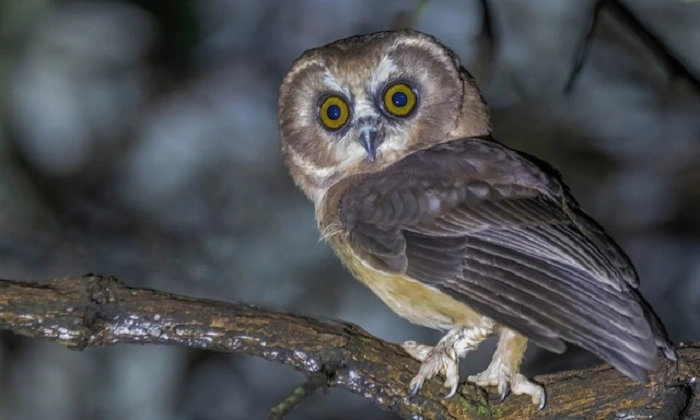
Small. Round. As quiet as dusk. The unspotted saw-whet owl is a guardian of Central American mysteries.
Differing from its northern cousin, its plumage smooth, plain brown. No markings. Plain elegance. Its size is compact—small enough to fit into the palm of a hand. But its voice carries. A series of soft toots heard echoing through darkness.
Rarely seen. Frequently heard. The unspotted saw-whet owl is a reminder that power need not be big. It needs to be there. And silence too can be a strength.
Also Read: Do Birds Eat Walnuts? A Complete Guide to Nuts, Nutrition, and Nature’s Foragers
Other Rare U Birds Worth Knowing
The letter U does not have many bird names but a couple of others more worthy of mention.
- Uniform Swift: A swift flyer darting through the skies of the tropics.
- Uvea Parakeet: A rare parrot of New Caledonia, treasured and endangered.
- Undulated Tinamou: A bird of South America, ground dwelling with patterned feathers.
Each one adds to the richness of this eclipsed letter. Each one whispers: there is always more to discover.
Common Characteristics of U Birds
What unites birds starting with U is not a letter. It is the air of uniqueness.
- The majority are shy, hidden in woods, reeds, or steep mountainsides.
- The majority are unusual, living on slender ranges or fragile ecosystems.
- The majority are indelible, beauty striking after being witnessed.
They remind us of hidden stanzas in the hymn of nature. Silent, but indelible after being sung.
Why Birds That Begin With U Are Important
It’s easy to forget the exception. To believe that since there are few, it doesn’t count. But U birds prove otherwise.
Umbrellabirds remind us that rainforests continue to hum with vibrations of thunder. Upland sandpipers remind us of grasslands we must not lose. Unicolored jays and blackbirds remind us that community and simplicity are to be treasured. Ultramarine flycatchers and Usambara weavers remind us that beauty has a tendency to thrive in the forgotten places. Unspotted owls remind us that even a whisper is important.
Birds starting with U are not just birds. They are lessons. They are metaphors. They are mirrors showing us resilience, liberty, imagination, and mystery.
FAQs On Birds Starting With U
Q1. What is the most famous bird starting with U?
The umbrellabird, whose booming voices and melodramatic crest.
Q2. Do there exist owls starting with U?
Yes. The unspotted saw-whet owl of Central America.
Q3. Which U bird is most easily seen in North America?
The upland sandpiper, typically on fence posts in fields.
Q4. Does any U bird shine bright colors?
Yes. The ultramarine flycatcher, shining sapphire blue.
Q5. Why are U birds so scarce?
Because names derive from human language, and very few species were named to begin with.
Closing Thoughts
The alphabet is raucous. S, C, and B bellowed with extravagance. But U murmurs. And in the murmur is power. The umbrellabird rumbling in the shrub. The upland sandpiper writes songs over grass. The ultramarine flycatcher shining over rock. The unicolored jay and blackbird singing in the trees and marsh. The Usambara weaver weaving art from twigs. The unspotted owl murmuring wisdom into night.
Birds starting with U are uncommon. But uncommon is not a weakness. It is strength. It is valuable. It is beauty that has been honed by scarcity. The next time you consider U, don’t consider it vacant. Consider unusual. Consider it unforgettable. Consider indomitable.
