

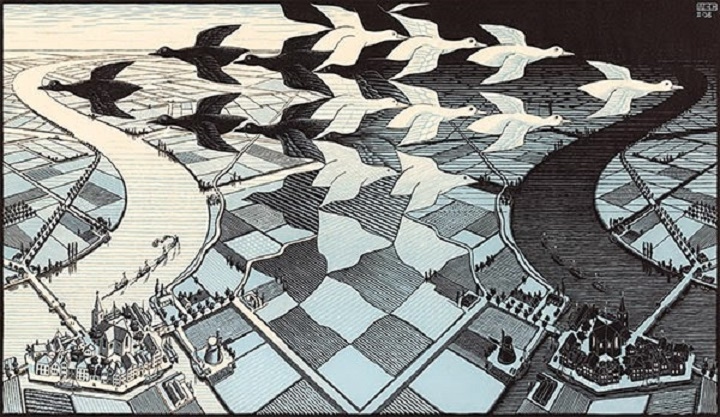
M.C. Escher, a Dutch graphic artist renowned for his mind-bending works, often played with visual perception, geometry, and symmetry. His iconic creations are filled with optical illusions, impossible constructions, and repetitive patterns. One of the recurring motifs in Escher’s art is birds. These avian creatures, often stylized and transformed in various ways, have become some of the most recognizable elements in his work. In this article, we will explore the fascinating relationship between M.C. Escher and birds, examining how he incorporated them into his art and the underlying meanings behind their presence.
M.C. Escher’s Bird-Inspired Art
Maurits Cornelis Escher, better known as M.C. Escher, was born in 1898 in the Netherlands and became a legendary figure in the world of graphic art. His works often defy traditional artistic perspectives, creating intricate patterns and impossible structures that make the viewer question the nature of space and form. Escher was a master of geometry, often using repeating shapes, tessellations, and illusions to create a sense of continuity and transformation.
Birds, in particular, played an essential role in Escher’s exploration of these themes. The evolution of birds in his works—from flying creatures to shapes that interlock and transform—demonstrates his fascination with transformation and the endless possibilities of visual art. These birds, while grounded in realism, often transcend their natural form, becoming part of Escher’s surreal and mathematical world.
In this article, we will look at Escher’s iconic works featuring birds, including his use of tessellation and transformation, and analyze the artistic techniques that made these works so revolutionary. Additionally, we will explore the significance of birds in Escher’s art, uncovering the deeper meanings behind their recurring appearance.
M.C. Escher’s Use of Birds: From Realistic Depictions to Transformations
The Role of Birds in Escher’s Tessellations
One of the most famous techniques employed by Escher was tessellation, the repetition of geometric shapes that fill a space without gaps or overlaps. Birds frequently appear in Escher’s tessellations, with their forms interlocking seamlessly in various patterns.
Sky and Water (1938)
One of Escher’s most well-known works featuring birds is Sky and Water (1938). This lithograph exemplifies Escher’s skill in tessellation, where the birds gradually transform into fish. At the top of the image, flying birds soar through the sky, their bodies shaped by perfect geometric patterns. As the viewer’s eye moves downward, these birds gradually morph into fish swimming in the water. This transformation of birds into aquatic creatures reflects Escher’s interest in the flow and continuity of forms.
The beauty of Sky and Water lies in Escher’s ability to seamlessly blend two different elements—birds and fish—into one cohesive image. The visual transition between the two is so smooth that it feels like a natural progression, yet it challenges our perception of reality. This technique demonstrates Escher’s mastery in creating art that challenges our understanding of space, shapes, and transformations.
Reptiles (1943)
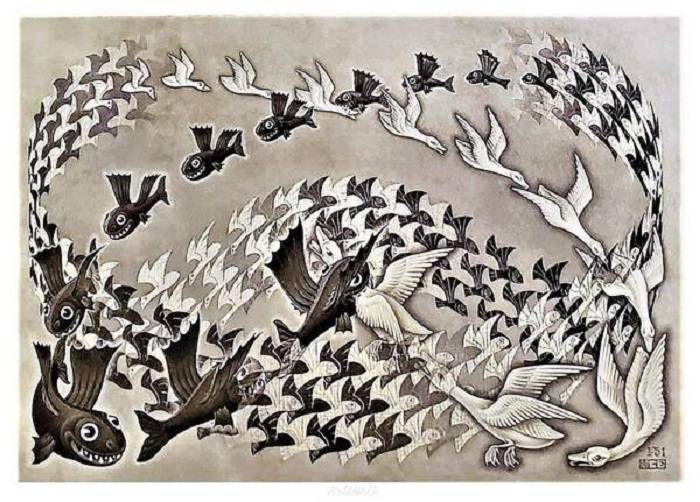
Another iconic tessellation involving birds can be found in Escher’s Reptiles (1943), where he uses creatures—both real and imaginary—to create a continuous pattern. In this lithograph, various reptiles (which are not birds per se) overlap and tessellate across the canvas, but the transformation of these creatures into birds at certain intervals demonstrates Escher’s ability to manipulate form and perception.
Escher’s birds in these tessellations are not just representations of natural creatures; they become part of a larger conceptual whole. These shapes and transformations reflect his desire to push boundaries and to create new worlds within the constraints of geometric art.
Birds in Escher’s Impossible Structures
Another hallmark of Escher’s work is his portrayal of impossible or paradoxical structures. These constructions, such as endless staircases or water flowing uphill, challenge the viewer’s understanding of physics and reality. Birds often appear in these surreal worlds, contributing to the sense of continuity and impossibility.
Ascending and Descending (1960)
In Ascending and Descending, a famous lithograph from 1960, Escher depicts an impossible staircase that seems to loop in on itself, with figures ascending and descending without end. At the top of this staircase, there are flying birds that appear to be locked in a continuous flight cycle, similar to the repetitive nature of the staircase. The birds in this piece suggest movement, but their positioning and the continuous nature of the staircase imply an endless loop—a visual representation of the paradox that defines Escher’s work.
The birds in this image serve as more than just decoration. They are a symbolic part of the impossible landscape, emphasizing the themes of infinite cycles and the constant motion that Escher loved to explore.
Relativity (1953)
Another famous work, Relativity, features multiple figures in a house where the laws of gravity seem to no longer apply. In this lithograph, birds can be seen flying across different planes of existence, where gravity shifts and changes direction at various points. The presence of the birds in Relativity further enhances the strange, disorienting nature of the piece, as they seem unaffected by the usual constraints of the physical world.
In Relativity, Escher again plays with the illusion of perspective, and the birds are part of that illusion. They are free from the normal laws of space and gravity, just as the figures in the artwork are free to walk on any surface, regardless of orientation. This surreal freedom mirrors the strange, upside-down world that Escher masterfully creates in his works.
Symbolism of Birds in Escher’s Art
While the technical mastery of Escher’s bird depictions is impressive in itself, the symbolism behind his use of birds adds depth to his works. In many cultures, birds are symbols of freedom, transcendence, and escape. In Escher’s art, however, birds often take on a more complex role. They serve as metaphors for the fluidity of form and the possibility of transformation.
Freedom and Movement
The most obvious symbolism of birds in Escher’s works is freedom. Birds, as creatures capable of flight, embody the concept of unrestrained movement. In Escher’s pieces, this idea is often challenged, as the birds undergo transformations that defy normal rules of movement. In Sky and Water, the birds’ transformation into fish suggests that even freedom is subject to change and limits. The birds’ flight through the impossible landscapes in Ascending and Descending further suggests that true freedom might be an illusion in Escher’s world.
The Interconnectedness of Life
Escher’s birds, particularly in his tessellations, are often depicted as part of a greater whole. They interlock and blend seamlessly with other forms, such as fish or reptiles. This interconnectedness reflects Escher’s belief in the unity of all things and his desire to show how everything in the universe is related. The transition from birds to fish, for example, might suggest that no matter how different life forms appear, they share underlying similarities.
The Legacy of MC Escher’s Birds
Escher’s birds remain some of the most recognizable and admired motifs in art. His intricate use of geometry, perspective, and transformation has left a lasting legacy in the world of art, particularly in the realm of graphic design and visual perception. His works featuring birds continue to inspire artists, designers, and mathematicians alike, as they explore the boundaries of illusion, form, and space.
From their symbolic meaning to their technical execution, the birds in Escher’s art encapsulate the artist’s fascination with the fluidity of life, the challenge of perspective, and the infinite possibilities of visual illusion.
FAQs about MC Escher’s Birds
What is the significance of birds in MC Escher’s art?
Birds in Escher’s art symbolize freedom, transformation, and the interconnectedness of life. They also serve as visual tools in his exploration of geometry and perspective.
Which Escher artwork features birds in a tessellation?
Sky and Water (1938) is a famous example where birds gradually transform into fish, showcasing Escher’s skill in tessellation and visual transformation.
How did Escher use birds in his impossible structures?
In works like Ascending and Descending (1960), birds are placed in impossible settings, enhancing the paradoxical nature of the structures and symbolizing infinite motion.
Why are birds important in Escher’s work on perspective?
Birds in Escher’s work often transcend the limitations of perspective, illustrating the fluidity of forms and challenging the viewer’s perception of reality.
What other creatures did Escher feature alongside birds?
In addition to birds, Escher frequently depicted reptiles, fish, and other animals, often blending them seamlessly into tessellated patterns or transforming them into new shapes.
M.C. Escher’s birds are far more than just decorative elements; they are integral parts of his exploration of geometry, perception, and the surreal. Through his use of birds in tessellations and impossible constructions, Escher challenged the boundaries of visual art and created works that continue to fascinate and inspire. His birds, ever fluid in form and meaning, embody the essence of transformation and the unending possibilities of visual illusion.
